


What If Self Sufficiency Could Meet Modern Life Half Way While Encouraging Social Connection and Community? Resilence is the Answer!
The idea of self-sufficiency has an obvious appeal. Growing your own food, generating your own energy, collecting rainwater and reducing your reliance on supermarkets and large-scale infrastructure can feel like a return to something simpler — and perhaps more sustainable.
But can true self-sufficiency actually work in modern life?
The short answer is: not entirely — and perhaps it doesn't need to.
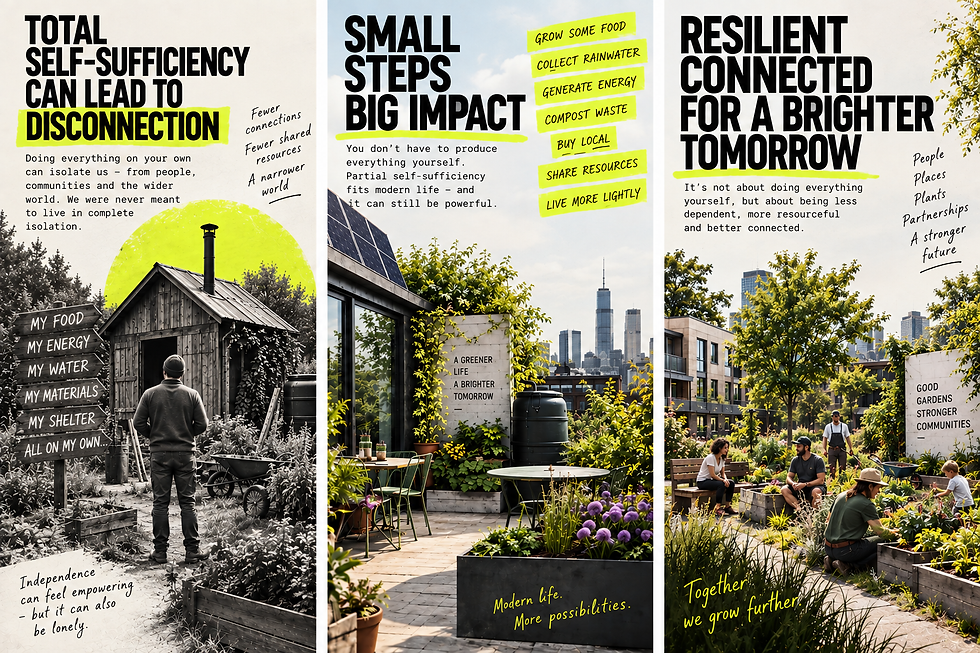
Complete self-sufficiency would mean producing almost everything you need yourself: food, water, energy, materials and potentially even clothing and building materials. For most people living in towns and cities, this simply isn't realistic. Modern life depends on complex networks of infrastructure, technology and specialist knowledge that would be difficult for an individual household to reproduce.
However, partial self-sufficiency is a different story.
A garden can produce herbs, fruit and vegetables. A rainwater system can reduce mains water consumption. Solar panels can generate electricity. Composting can turn household and garden waste into a useful resource. Even something as simple as planting perennial crops or creating a productive edible landscape can reduce dependence on external systems.
The bigger opportunity may therefore be to think beyond self-sufficiency and towards resilience.
A resilient household doesn't need to produce everything itself. Instead, it has multiple ways of meeting its needs. It might grow some food, buy the rest locally, generate some energy and remain connected to the national grid. It might collect rainwater while still having access to mains water. It might share tools, knowledge and resources with neighbours rather than every household owning everything independently.
This approach also recognises something important: humans have always depended on one another. Communities, trade and shared resources are not failures of self-sufficiency; they are part of how societies function.
For landscape design, this creates an interesting question. What if our gardens weren't simply spaces for decoration or recreation, but small pieces of productive infrastructure?
A garden could provide food, habitat, shade, water storage, materials, social space and even energy — while still looking beautiful.
Perhaps the future isn't about becoming completely self-sufficient.
Perhaps it's about becoming less dependent, more resourceful and better connected to the systems around us.


Comments